
India Saves Rs 4 Lakh Cr on Renewables in 2024
x
India's renewable energy capacity helped save Rs 4 lakh crore in fossil fuel and pollution costs in 2024, achieving 50% non-fossil fuel capacity five years ahead of schedule.
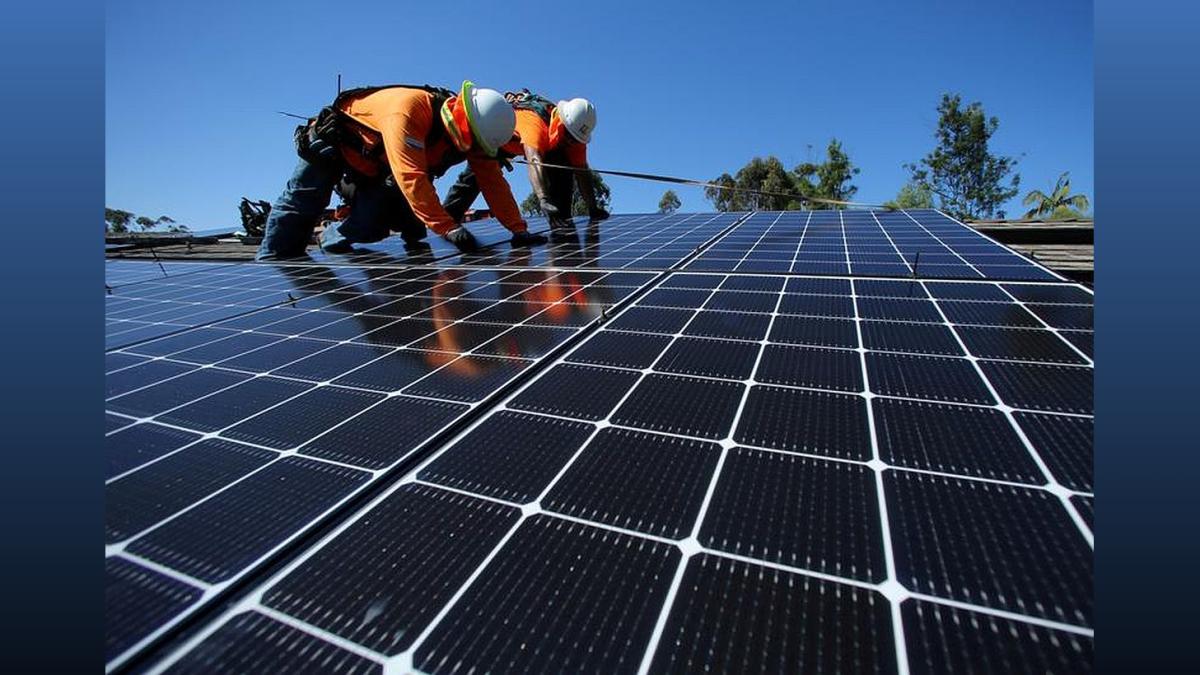
Photograph: Mike Blake/Reuters
New Delhi, Jul 24 (PTI) The installed capacity of renewables has helped the country save Rs 4 lakh crore in fossil fuel and pollution-related costs in 2024, Union Minister Pralhad Joshi said on Thursday.
The Minister for New and Renewable Energy made the remarks while addressing Mercom Renewables Summit 2025 in the national capital.
India has already achieved 50 per cent of its installed power capacity from non-fossil fuel sources, five years ahead of schedule, Joshi said. "This is a historic milestone."
The country's renewable energy capacity has crossed the 245-GW mark, of which over 116 GW is solar and 52 GW wind, the minister said.
Citing a report of IRENA (International Renewable Energy Agency), Joshi said, "Rising installed capacity of renewables by India in 2024 helped save roughly Rs 4 lakh crore (more than USD 46 billion) in fossil fuel and pollution-related costs."
He said over 58.7 lakh applications and 17.2 lakh completed installations under PM Surya Ghar: Muft Bijli Yojana, which is also the world's largest domestic rooftop solar initiative.
India is moving ahead with its goal of 500 GW non-fossil capacity by 2030, Joshi said to the gathering of over 500, including industry executives, policymakers, and investors, government officials.
The government is working on multidimensional approach to achieve the ambitious goal, he said.
The government is working on strengthening power purchase agreements (PPAs) and has conducted zonal review meetings with several chief ministers and state DISCOMs on the issue, he said.
Modernising the grid and enhancing storage, a viability gap funding scheme for 30 GWh of Battery Energy Storage Systems (BESS) has been approved. It will be supplementing the 13.2 GWh already in progress.
This Rs 5,400-crore initiative is expected to mobilise Rs 33,000 crore in investments and meet the nation's BESS demand by 2028.
Third, domestic manufacturing and innovation is being promoted through schemes like the PLI and ALMM initiative.
"The Rs 24,000 crore production-linked incentive (PLI) scheme is enabling India to build Atma Nirbharta in solar and wind manufacturing, The Approved List of Models and Manufacturers (ALMM) List-II for solar PV cells will be implemented from June 2026," he said.
The government is also working to facilitate land access and lastly ensuring financial stability and market confidence.
On the Green Hydrogen Mission, he said incentives have already been awarded for 3,000 MW per annum of electrolyser manufacturing capacity. Over 8.6 lakh tonnes per annum of green hydrogen production capacity has been allocated.
"With global dynamics shifting, India has a chance to take a much larger leadership role and seize greater market share," Raj Prabhu, CEO of US-based Mercom Capital Group, said.
The Minister for New and Renewable Energy made the remarks while addressing Mercom Renewables Summit 2025 in the national capital.
India has already achieved 50 per cent of its installed power capacity from non-fossil fuel sources, five years ahead of schedule, Joshi said. "This is a historic milestone."
The country's renewable energy capacity has crossed the 245-GW mark, of which over 116 GW is solar and 52 GW wind, the minister said.
Citing a report of IRENA (International Renewable Energy Agency), Joshi said, "Rising installed capacity of renewables by India in 2024 helped save roughly Rs 4 lakh crore (more than USD 46 billion) in fossil fuel and pollution-related costs."
He said over 58.7 lakh applications and 17.2 lakh completed installations under PM Surya Ghar: Muft Bijli Yojana, which is also the world's largest domestic rooftop solar initiative.
India is moving ahead with its goal of 500 GW non-fossil capacity by 2030, Joshi said to the gathering of over 500, including industry executives, policymakers, and investors, government officials.
The government is working on multidimensional approach to achieve the ambitious goal, he said.
The government is working on strengthening power purchase agreements (PPAs) and has conducted zonal review meetings with several chief ministers and state DISCOMs on the issue, he said.
Modernising the grid and enhancing storage, a viability gap funding scheme for 30 GWh of Battery Energy Storage Systems (BESS) has been approved. It will be supplementing the 13.2 GWh already in progress.
This Rs 5,400-crore initiative is expected to mobilise Rs 33,000 crore in investments and meet the nation's BESS demand by 2028.
Third, domestic manufacturing and innovation is being promoted through schemes like the PLI and ALMM initiative.
"The Rs 24,000 crore production-linked incentive (PLI) scheme is enabling India to build Atma Nirbharta in solar and wind manufacturing, The Approved List of Models and Manufacturers (ALMM) List-II for solar PV cells will be implemented from June 2026," he said.
The government is also working to facilitate land access and lastly ensuring financial stability and market confidence.
On the Green Hydrogen Mission, he said incentives have already been awarded for 3,000 MW per annum of electrolyser manufacturing capacity. Over 8.6 lakh tonnes per annum of green hydrogen production capacity has been allocated.
"With global dynamics shifting, India has a chance to take a much larger leadership role and seize greater market share," Raj Prabhu, CEO of US-based Mercom Capital Group, said.
You May Like To Read


TODAY'S MOST TRADED COMPANIES
- Company Name
- Price
- Volume
- Vodafone-Idea-L
- 11.55 (+ 2.67)
- 78862178
- Harshil-Agrotech
- 0.61 (+ 8.93)
- 23146088
- Mangalam-Industrial
- 0.91 (+ 1.11)
- 22851067
- Srestha-Finvest
- 0.34 (+ 13.33)
- 20054649
- Alstone-Textiles
- 0.29 ( 0.00)
- 13956593
MORE NEWS


 © 2025 Rediff.com India Limited. All rights reserved. Disclaimer - Terms of Service - Privacy Policy - Feedback