
Nano Urea: Govt, ICAR Sign Rs 21 Cr Evaluation MoU
x
Govt & ICAR partner for a 5-year, Rs 21 cr nano urea evaluation project. Focus on field efficacy, crop growth, & soil health.

New Delhi, Dec 5 (PTI) In a bid to assess the field-level efficacy of nano fertilisers, the government has signed an MoU with the Indian Council of Agricultural Research (ICAR) for a network project focused on nano urea, Union Minister Anupriya Patel informed the Lok Sabha on Friday.
The five-year initiative under the MoU signed on November 3, 2025, with a total outlay of Rs 21.20 crore (including GST), will be jointly funded by fertiliser public sector undertakings and cooperatives, the Minister of State for Fertilisers said in her written reply.
The project will be carried out across multiple agricultural universities and institutes, including the ICAR-Central Rice Research Institute (CRRI) in Cuttack, Odisha.
The minister said the ICAR also launched another project in August 2024, backed by the Indian Council for Fertilizers and Fertilizer Technology Research (ICFFTR) with an allocation of Rs 1.60 crore. Spanning two years, it aims to study the effects of nano fertilisers on crop growth, soil health and nutrient uptake in diverse agro-ecological zones.
Meanwhile, the Indian Farmers Fertiliser Cooperative (IFFCO) has conducted evaluations of its nano fertilisers in drought-prone districts such as Balangir, focusing on crops like paddy, cotton and brinjal. These included farmer field trials and collaborations with the Odisha University of Agriculture and Technology (OUAT) in Bhubaneswar.
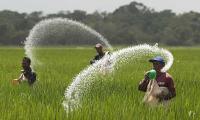
Trials on brinjal at the Regional Research and Technology Transfer Station (RRTTS) of OUAT in Bhawanipatna, Kalahandi, and on paddy at OUAT's Seed Research Farm in Bargarh, showed improved yields even with a 25-50 per cent reduction in conventional chemical fertiliser doses, she said.
For the 2024-25 fiscal year, sales of nano urea reached 273.62 lakh bottles (500 ml each), alongside 160 lakh bottles of nano DAP, underscoring growing adoption of the technology.
The five-year initiative under the MoU signed on November 3, 2025, with a total outlay of Rs 21.20 crore (including GST), will be jointly funded by fertiliser public sector undertakings and cooperatives, the Minister of State for Fertilisers said in her written reply.
The project will be carried out across multiple agricultural universities and institutes, including the ICAR-Central Rice Research Institute (CRRI) in Cuttack, Odisha.
The minister said the ICAR also launched another project in August 2024, backed by the Indian Council for Fertilizers and Fertilizer Technology Research (ICFFTR) with an allocation of Rs 1.60 crore. Spanning two years, it aims to study the effects of nano fertilisers on crop growth, soil health and nutrient uptake in diverse agro-ecological zones.
Meanwhile, the Indian Farmers Fertiliser Cooperative (IFFCO) has conducted evaluations of its nano fertilisers in drought-prone districts such as Balangir, focusing on crops like paddy, cotton and brinjal. These included farmer field trials and collaborations with the Odisha University of Agriculture and Technology (OUAT) in Bhubaneswar.
Trials on brinjal at the Regional Research and Technology Transfer Station (RRTTS) of OUAT in Bhawanipatna, Kalahandi, and on paddy at OUAT's Seed Research Farm in Bargarh, showed improved yields even with a 25-50 per cent reduction in conventional chemical fertiliser doses, she said.
For the 2024-25 fiscal year, sales of nano urea reached 273.62 lakh bottles (500 ml each), alongside 160 lakh bottles of nano DAP, underscoring growing adoption of the technology.
You May Like To Read

TODAY'S MOST TRADED COMPANIES
- Company Name
- Price
- Volume
- Vodafone-Idea-L
- 11.25 (+ 4.85)
- 124593459
- Mangalam-Industrial
- 0.90 (+ 4.65)
- 43018654
- Welcure-Drugs-and
- 0.50 (+ 4.17)
- 39983710
- Alstone-Textiles
- 0.29 ( -3.33)
- 27516634
- Murae-Organisor
- 0.27 (+ 3.85)
- 26520405
MORE NEWS


 © 2025 Rediff.com India Limited. All rights reserved. Disclaimer - Terms of Service - Privacy Policy - Feedback