
New Labour Codes: Supply Chains, Wages, Skilling
x
New Labour Codes in India aim for frictionless supply chains, universal wage coverage, and enhanced skilling. Key reforms and impacts discussed.
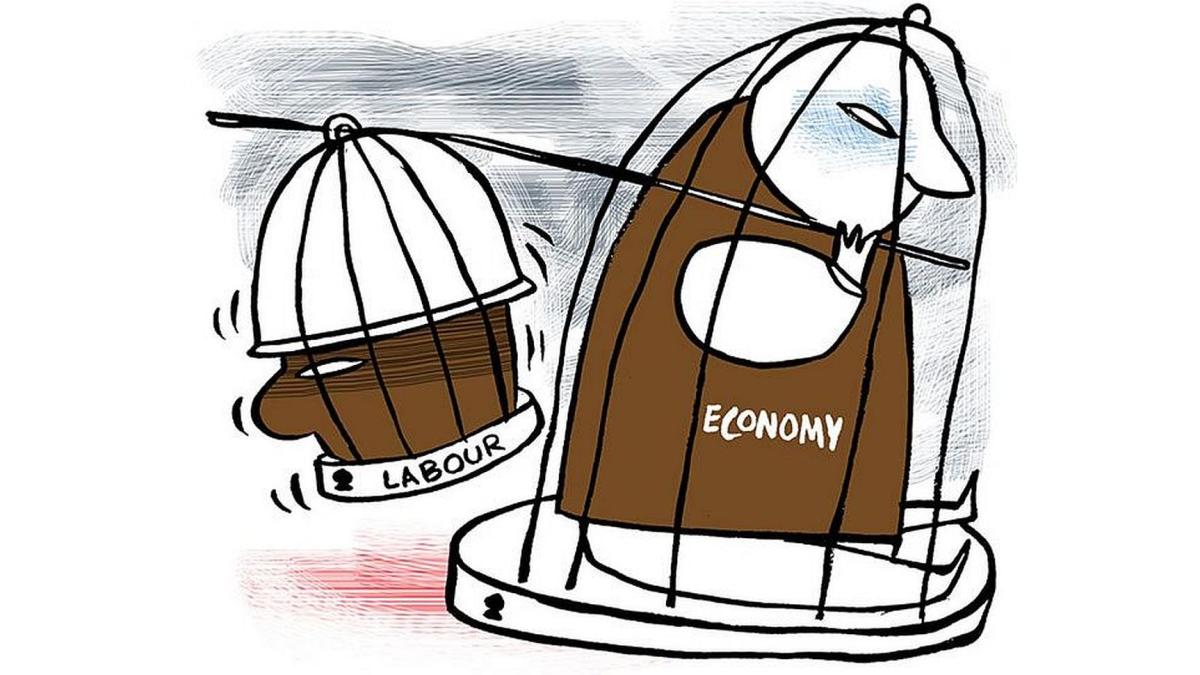
Illustration: Uttam Ghosh/Rediff.com
New Delhi, Dec 12 (PTI) New Labour Codes will ensure frictionless supply chains, universal wage coverage and enhance skilling, said a senior official on Friday.
The government notified the four labour codes last month and will soon notify the rules under these laws.
Speaking at the 91st Annual General Meeting and Annual Convention of the All India Association of Employers (AIOE), Alok Chandra, Senior Labour and Employment Advisor at the Union Ministry of Labour & Employment, stated that new labour codes attempt to achieve frictionless supply chains, enhanced skilling infrastructure and universal wage coverage.
He outlined that consolidating 29 separate labour laws into four unified codes would eliminate regulatory inconsistencies that have long hindered industrial efficiency.
The supply chain benefits stem from standardisation across the regulatory landscape.
The codes introduce consistent definitions of key terms across all four codes and establish national standards for safety regulation, eliminating the fragmentation created by laws enacted piecemeal from 1923 onwards.
"If there's consistency or congruence between the definitions as well as the safety standards which will ultimately govern the production process, this will facilitate a very smooth supply chain," Chandra explained.
In workforce development, the government has created a dedicated reskilling fund, partly financed by amounts credited after the compounding of offences.
While the wage reforms represent the most significant expansion of worker protection. Minimum wages have been universalised across all sectors, eliminating the previous system of 45 scheduled employments.
Besides, the introduction of a floor wage prevents states from setting rates below the national threshold, whilst allowing existing higher rates to remain.
"This floor wage to a very large extent addresses the issue of equity," Chandra said, responding to concerns about regional wage disparities.
On occasion, Jasbir Singh, President of AIOE and Executive Chairman, CEO & Whole-Time Director of Amber Enterprises, characterised the codes as establishing "a balanced architecture that supports both enterprises and workers."
Employers gain simplified compliance and reduced regulatory burden, whilst workers receive expanded social security, reinforced safety protections and formal recognition of emerging work arrangements, including gig and platform.
He emphasised the need for enabling measures, including state-level uniformity, phased implementation to assist micro, small and medium enterprises, strengthening a unified digital compliance system and capacity-building programmes.
Ravi Peiris, Officer in Charge, ILO DWT for South Asia and Country Office, India, described the codes as creating "a strong foundation to a stable industrial relations system" that balances equity and efficiency.
"India has taken the lead in granting coverage for gig and platform workers," he said, highlighting that it is a demonstration of India's commitment to eradicate informality.
Atul Sobti, DG, SCOPE, and Member ILO GB, Geneva, highlighted India's transformation "from fragile five to top five economies" and noted international recognition of the labour code initiative.
"We have come from an era of conflict, contention and confrontation to an era of conversation, consultation and cooperation."
He also stressed employer responsibilities in workforce reskilling, particularly for the energy transition and emerging technologies, and mapping skills gap.
Akustina Morni, Director of Policy at the International Organisation of Employers in Geneva, praised India's 'vital and constructive role' in supporting the employers group in global labour discussions, particularly in the G20, International Labour Conference and ILO Governing Body.
She expressed hope that India would continue supporting a balanced platform economy instrument that fosters an enabling environment for businesses, particularly MSMEs.
The convention also saw the release of a white paper titled "Breaking the Glass Ceiling: How the Labour Codes Boost Women's Participation in India's Workforce," jointly published by AIOE and Shardul Amarchand Mangaldas & Co. The paper examines how modernised regulations, expanded social security and recognition of flexible work models strengthen foundations for women's employment whilst acknowledging persistent challenges, including care burdens and pay gaps.
AIOE also gave out the National Award for Outstanding Industrial Relations 2024-25.
The government notified the four labour codes last month and will soon notify the rules under these laws.
Speaking at the 91st Annual General Meeting and Annual Convention of the All India Association of Employers (AIOE), Alok Chandra, Senior Labour and Employment Advisor at the Union Ministry of Labour & Employment, stated that new labour codes attempt to achieve frictionless supply chains, enhanced skilling infrastructure and universal wage coverage.
He outlined that consolidating 29 separate labour laws into four unified codes would eliminate regulatory inconsistencies that have long hindered industrial efficiency.
The supply chain benefits stem from standardisation across the regulatory landscape.
The codes introduce consistent definitions of key terms across all four codes and establish national standards for safety regulation, eliminating the fragmentation created by laws enacted piecemeal from 1923 onwards.
"If there's consistency or congruence between the definitions as well as the safety standards which will ultimately govern the production process, this will facilitate a very smooth supply chain," Chandra explained.
In workforce development, the government has created a dedicated reskilling fund, partly financed by amounts credited after the compounding of offences.
While the wage reforms represent the most significant expansion of worker protection. Minimum wages have been universalised across all sectors, eliminating the previous system of 45 scheduled employments.
Besides, the introduction of a floor wage prevents states from setting rates below the national threshold, whilst allowing existing higher rates to remain.
"This floor wage to a very large extent addresses the issue of equity," Chandra said, responding to concerns about regional wage disparities.
On occasion, Jasbir Singh, President of AIOE and Executive Chairman, CEO & Whole-Time Director of Amber Enterprises, characterised the codes as establishing "a balanced architecture that supports both enterprises and workers."
Employers gain simplified compliance and reduced regulatory burden, whilst workers receive expanded social security, reinforced safety protections and formal recognition of emerging work arrangements, including gig and platform.
He emphasised the need for enabling measures, including state-level uniformity, phased implementation to assist micro, small and medium enterprises, strengthening a unified digital compliance system and capacity-building programmes.
Ravi Peiris, Officer in Charge, ILO DWT for South Asia and Country Office, India, described the codes as creating "a strong foundation to a stable industrial relations system" that balances equity and efficiency.
"India has taken the lead in granting coverage for gig and platform workers," he said, highlighting that it is a demonstration of India's commitment to eradicate informality.
Atul Sobti, DG, SCOPE, and Member ILO GB, Geneva, highlighted India's transformation "from fragile five to top five economies" and noted international recognition of the labour code initiative.
"We have come from an era of conflict, contention and confrontation to an era of conversation, consultation and cooperation."
He also stressed employer responsibilities in workforce reskilling, particularly for the energy transition and emerging technologies, and mapping skills gap.
Akustina Morni, Director of Policy at the International Organisation of Employers in Geneva, praised India's 'vital and constructive role' in supporting the employers group in global labour discussions, particularly in the G20, International Labour Conference and ILO Governing Body.
She expressed hope that India would continue supporting a balanced platform economy instrument that fosters an enabling environment for businesses, particularly MSMEs.
The convention also saw the release of a white paper titled "Breaking the Glass Ceiling: How the Labour Codes Boost Women's Participation in India's Workforce," jointly published by AIOE and Shardul Amarchand Mangaldas & Co. The paper examines how modernised regulations, expanded social security and recognition of flexible work models strengthen foundations for women's employment whilst acknowledging persistent challenges, including care burdens and pay gaps.
AIOE also gave out the National Award for Outstanding Industrial Relations 2024-25.
You May Like To Read

TODAY'S MOST TRADED COMPANIES
- Company Name
- Price
- Volume
- Vodafone-Idea-L
- 11.65 (+ 3.56)
- 106772451
- Alstone-Textiles
- 0.28 ( -3.45)
- 44187760
- Mangalam-Industrial
- 0.88 ( -2.22)
- 39177573
- Sunshine-Capital
- 0.27 (+ 3.85)
- 35956340
- GMR-Airports
- 104.40 (+ 6.37)
- 30453005
MORE NEWS

 © 2025 Rediff.com India Limited. All rights reserved. Disclaimer - Terms of Service - Privacy Policy - Feedback