
Sensex Resilient Amidst India-Pakistan Tensions: Anand Rathi Research
x
Despite recent India-Pakistan tensions, the Sensex has shown remarkable resilience, according to Anand Rathi Research. Learn about the market's response and the factors driving its strength.

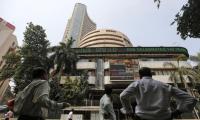
Photograph: Danish Siddiqui/Reuters
New Delhi, May 7 (PTI) Indian equity markets showed resilience and ended higher on Wednesday, the day when India launched missile strikes on terrorist hideouts in Pakistan and Pakistan-Occupied Kashmir to avenge the Pahalgam attack.
Even amid such volatility in sentiment, Indian equity markets have displayed their characteristic poise so far, according to Anand Rathi Research Team.
After gyrating between highs and lows during the day, the 30-share BSE Sensex ended 105.71 points or 0.13 per cent higher at 80,746.78. In intra-day trade, the Sensex hit a high of 80,844.63 and a low of 79,937.48.
The Nifty-50 of NSE advanced by 34.80 points or 0.14 per cent to settle at 24,414.40. Nifty moved between a high of 24,449.60 and a low of 24,220 during the session.
Since the 1990s, several high-stake India-Pakistan episodes -- from Kargil and Parliament attacks to Uri and Pulwama -- have tested nerves. But the Sensex has consistently demonstrated a remarkable immunity to sabre-rattling, a report by Anand Rathi Research Team said.
Market corrections, if any, have been modest, short-lived and largely sentiment-driven. Fundamentals have prevailed, the report added.
Highlighting the reasons for markets resilience, Anand Rathi Research said, probability of full-scale conflict remains low. "Both nations, despite the heated rhetoric, have typically avoided escalation beyond tactical thresholds," it added.
Also, investors are adept at distinguishing noise versus fundamentals. Earnings, liquidity, policy direction and macro stability continue to drive flows, and not border tensions, the report said.
Equity and FPI data show that even in peak crisis moments, markets have rebounded swiftly, it added.
"While short-term volatility is always a possibility, we do not expect a structural impact on Indian equities. The broader market narrative continues to be shaped by India's domestic macro strength, and not by its external fault lines," the report said.
The average (mean) Sensex correction at the lowest points during Indo-Pak tensions was 7.5 per cent, and the median, 3.5 per cent. In relative terms (vs. S&P 500), both mean and median were positive, indicating outperformance by India during these periods.
"Yet, even if the situation becomes war-like (mass troop mobilisation or sector-specific conventional warfare), we do not expect the Nifty-50 to correct beyond 5-10 per cent," it added.
Both the benchmark indices Sensex and Nifty have climbed over 1 per cent since the Pahalgam terror attack on April 22.
Even amid such volatility in sentiment, Indian equity markets have displayed their characteristic poise so far, according to Anand Rathi Research Team.
After gyrating between highs and lows during the day, the 30-share BSE Sensex ended 105.71 points or 0.13 per cent higher at 80,746.78. In intra-day trade, the Sensex hit a high of 80,844.63 and a low of 79,937.48.
The Nifty-50 of NSE advanced by 34.80 points or 0.14 per cent to settle at 24,414.40. Nifty moved between a high of 24,449.60 and a low of 24,220 during the session.
Since the 1990s, several high-stake India-Pakistan episodes -- from Kargil and Parliament attacks to Uri and Pulwama -- have tested nerves. But the Sensex has consistently demonstrated a remarkable immunity to sabre-rattling, a report by Anand Rathi Research Team said.
Market corrections, if any, have been modest, short-lived and largely sentiment-driven. Fundamentals have prevailed, the report added.
Highlighting the reasons for markets resilience, Anand Rathi Research said, probability of full-scale conflict remains low. "Both nations, despite the heated rhetoric, have typically avoided escalation beyond tactical thresholds," it added.
Also, investors are adept at distinguishing noise versus fundamentals. Earnings, liquidity, policy direction and macro stability continue to drive flows, and not border tensions, the report said.
Equity and FPI data show that even in peak crisis moments, markets have rebounded swiftly, it added.
"While short-term volatility is always a possibility, we do not expect a structural impact on Indian equities. The broader market narrative continues to be shaped by India's domestic macro strength, and not by its external fault lines," the report said.
The average (mean) Sensex correction at the lowest points during Indo-Pak tensions was 7.5 per cent, and the median, 3.5 per cent. In relative terms (vs. S&P 500), both mean and median were positive, indicating outperformance by India during these periods.
"Yet, even if the situation becomes war-like (mass troop mobilisation or sector-specific conventional warfare), we do not expect the Nifty-50 to correct beyond 5-10 per cent," it added.
Both the benchmark indices Sensex and Nifty have climbed over 1 per cent since the Pahalgam terror attack on April 22.
You May Like To Read


TODAY'S MOST TRADED COMPANIES
- Company Name
- Price
- Volume
- Vodafone-Idea-L
- 11.65 (+ 3.56)
- 106772451
- Alstone-Textiles
- 0.28 ( -3.45)
- 44187760
- Mangalam-Industrial
- 0.88 ( -2.22)
- 39177573
- Sunshine-Capital
- 0.27 (+ 3.85)
- 35956340
- GMR-Airports
- 104.40 (+ 6.37)
- 30453005
MORE NEWS

 © 2025 Rediff.com India Limited. All rights reserved. Disclaimer - Terms of Service - Privacy Policy - Feedback